
H. pylori Breath Test: A Comprehensive Guide
Navigating Helicobacter pylori detection requires clear guidance. This resource details the breath test process, offering essential instructions for accurate results and successful treatment planning.
Helicobacter pylori (H. pylori) is a common bacterium that infects the stomach, often without causing immediate symptoms. However, long-term infection can lead to gastritis, peptic ulcers, and even an increased risk of stomach cancer. Accurate detection of H. pylori is, therefore, crucial for timely intervention and preventing serious health complications.
Several methods exist for diagnosing H. pylori infection, including invasive procedures like endoscopy with biopsy and non-invasive tests such as stool antigen tests and serological blood tests. However, the urea breath test (UBT) has emerged as a highly accurate and convenient option.
The UBT is a non-invasive test that relies on the unique metabolic activity of H. pylori. It’s a simple procedure, typically performed in a clinical setting, and doesn’t require any preparation beyond following specific dietary and medication guidelines – which will be detailed later. This guide provides a comprehensive overview of the UBT, covering everything from the underlying science to interpreting your results and understanding post-test instructions. We aim to empower you with the knowledge needed to confidently navigate the testing process and take proactive steps towards your health.
Why is H. pylori Detection Important?
Detecting Helicobacter pylori infection is paramount due to its significant impact on gastrointestinal health and potential long-term consequences. While many individuals harbor the bacteria asymptomatically, it’s a primary cause of several debilitating conditions.
Untreated H. pylori infection can lead to chronic gastritis, characterized by inflammation of the stomach lining. This inflammation can progress to peptic ulcers – painful sores in the stomach or duodenum. Beyond immediate discomfort, these ulcers can cause bleeding, obstruction, and perforation, requiring urgent medical attention.
More alarmingly, chronic H. pylori infection is a well-established risk factor for gastric cancer, particularly adenocarcinoma. Early detection and eradication of the bacteria can significantly reduce this risk. Furthermore, identifying H. pylori is crucial before initiating proton pump inhibitor (PPI) therapy for heartburn or indigestion, as PPIs can mask symptoms and potentially interfere with accurate diagnosis.
Therefore, proactive testing, especially in individuals with concerning symptoms or a family history of gastric issues, is vital for preventing complications and ensuring optimal gastrointestinal well-being. Successful treatment improves quality of life and reduces the burden of related health problems.
Understanding the Urea Breath Test (UBT)
The Urea Breath Test (UBT) is a non-invasive and highly accurate method for detecting Helicobacter pylori infection. It’s considered a preferred diagnostic tool due to its convenience and minimal risk to the patient, unlike more invasive procedures like endoscopy.
The UBT relies on the unique ability of H. pylori to produce an enzyme called urease. This enzyme breaks down urea, a compound naturally present in the body, into ammonia and carbon dioxide. The test specifically measures the levels of carbon dioxide produced in the breath after consuming a urea-containing substance.
There are two primary forms of the UBT: using a urea capsule or a urea-containing liquid. Both methods deliver the urea substrate to the stomach. If H. pylori is present, the urease enzyme will rapidly break down the urea, leading to a detectable increase in 13C or 14C-labeled carbon dioxide in the breath.
The test involves collecting two breath samples – one before and one after urea ingestion – and analyzing them using isotope ratio mass spectrometry. The difference in carbon dioxide levels indicates the presence or absence of the bacteria. It’s a reliable and widely accepted method for H. pylori diagnosis.
How Does the UBT Work? ౼ The Science Behind It
The Urea Breath Test (UBT) hinges on a fascinating biochemical process. It leverages Helicobacter pylori’s production of urease, an enzyme crucial for its survival in the acidic stomach environment. Urease catalyzes the hydrolysis of urea – (NH2)2CO – into ammonia (NH3) and carbon dioxide (CO2).
The urea administered during the test isn’t ordinary urea; it’s labeled with a non-radioactive isotope of carbon, either 13C or 14C. This isotopic labeling allows for precise tracking of the carbon dioxide produced. If H. pylori is present, the ingested 13C/14C-urea is rapidly broken down by the bacterial urease.
The resulting 13C/14C-labeled carbon dioxide is absorbed into the bloodstream and exhaled through the lungs. Breath samples are collected before and typically 20-30 minutes after urea ingestion. These samples are then analyzed using isotope ratio mass spectrometry.
A significant increase in the levels of 13C/14C-labeled carbon dioxide in the second breath sample, compared to the baseline, confirms the presence of active H. pylori infection. The magnitude of the increase correlates with the bacterial load within the stomach.
Advantages of the Breath Test Over Other Methods
The Urea Breath Test (UBT) presents several compelling advantages compared to alternative methods for Helicobacter pylori detection. Unlike endoscopic biopsies, the UBT is entirely non-invasive, eliminating the risks associated with sedation and instrumentation. This makes it particularly suitable for patients who are anxious about endoscopy or have contraindications to the procedure.
Compared to stool antigen tests, the UBT generally exhibits higher accuracy, especially after proton pump inhibitor (PPI) therapy. Stool tests can yield false negatives due to intermittent antigen shedding or recent antibiotic use. The UBT, however, directly assesses active bacterial urease activity.
Furthermore, the UBT avoids the potential for sampling error inherent in biopsies, which may not accurately represent the overall infection status within the stomach. It’s also well-tolerated by most patients, with minimal discomfort.
The test is rapid, providing results within a relatively short timeframe. Finally, the UBT doesn’t require specialized training for sample collection, making it accessible in a wider range of clinical settings. It’s a convenient and reliable diagnostic tool.

Preparing for the H. pylori Breath Test
Proper preparation is crucial for obtaining accurate results from your Helicobacter pylori breath test. Carefully following these instructions will maximize the test’s reliability. Begin by reviewing the complete list of dietary and medication restrictions provided by your healthcare provider or in the accompanying test kit instructions.
Typically, preparation starts one week before the scheduled test. This involves discontinuing any medications that could interfere with the test’s accuracy, such as antibiotics, bismuth subsalicylate (Pepto-Bismol), and proton pump inhibitors (PPIs) – like omeprazole or lansoprazole. Your doctor will advise on the safe duration of discontinuation.
Avoid taking antacids within 24 hours of the test. It’s also essential to understand the dietary guidelines, which usually require avoiding certain foods. Ensure you have a clear understanding of the timing for your last meal before the test.
Read the provided patient instructions PDF thoroughly. If you have any questions or concerns regarding your preparation, don’t hesitate to contact your doctor’s office for clarification. Successful preparation is key to a dependable diagnosis.
Dietary Restrictions Before the Test
Strict adherence to dietary guidelines is paramount for a reliable Helicobacter pylori breath test. These restrictions minimize interference with the urea metabolism process the test measures. Generally, you’ll need to avoid certain foods for 24-48 hours prior to your appointment – always confirm the specific timeframe with your provider.
Avoid consuming dairy products, as they can affect gastric emptying and potentially influence results. Similarly, refrain from eating meat, poultry, and fish. These protein-rich foods can stimulate urea production independent of H. pylori, leading to inaccurate readings.

Limit your intake of complex carbohydrates like bread, pasta, rice, and potatoes. Simple sugars are generally permitted in small quantities. Fruits and vegetables are usually allowed, but check the specific list provided in your test kit’s PDF instructions.
Do not chew gum or consume mints before the test, as these can stimulate gastric acid production. Water is permitted, but avoid carbonated beverages. Carefully review the complete dietary restrictions outlined in the patient information sheet to ensure optimal test accuracy.
Medication Considerations – What to Avoid
Several medications can significantly interfere with the accuracy of the Helicobacter pylori breath test. It’s crucial to inform your doctor about all medications, supplements, and over-the-counter drugs you are currently taking. Antibiotics, even those taken for conditions unrelated to your stomach, must be stopped at least two weeks before the test – consult your physician before discontinuing any prescribed antibiotic.
Proton pump inhibitors (PPIs) – like omeprazole, lansoprazole, and pantoprazole – suppress acid production and can lead to false-negative results. Discontinue PPIs for 5-7 days prior to testing, as detailed in your test’s PDF instructions. Similarly, H2-receptor antagonists (e.g., ranitidine, famotidine) should be avoided for 24 hours before the test.
Bismuth-containing medications (like Pepto-Bismol) can also impact results and should be stopped for at least one week. Antacids may need to be avoided the day before the test. Always refer to the comprehensive medication list provided with your test kit or discuss any concerns with your healthcare provider to ensure reliable results.
Smoking and Alcohol – Impact on Test Results
Both smoking and alcohol consumption can significantly affect the accuracy of the Helicobacter pylori breath test, potentially leading to false-negative results. Smoking alters gastric emptying and can influence the metabolism of the urea substrate used in the test, masking the presence of the bacteria. Therefore, you must abstain from smoking for at least six hours – ideally 12 hours – before your scheduled breath test. Review the specific timeframe detailed in your test’s PDF instructions.
Alcohol, similar to smoking, can impact gastric physiology and urea metabolism. It’s essential to avoid all alcoholic beverages for a minimum of 24 hours prior to the test. This includes beer, wine, and spirits. Even small amounts of alcohol can interfere with the test’s reliability.
Strict adherence to these guidelines is crucial for obtaining accurate results. Your healthcare provider may provide a more detailed list of substances to avoid. If you have concerns about your ability to abstain, discuss them with your doctor before the test to ensure the most reliable assessment of H. pylori infection.
The H. pylori Breath Test Procedure ౼ Step-by-Step
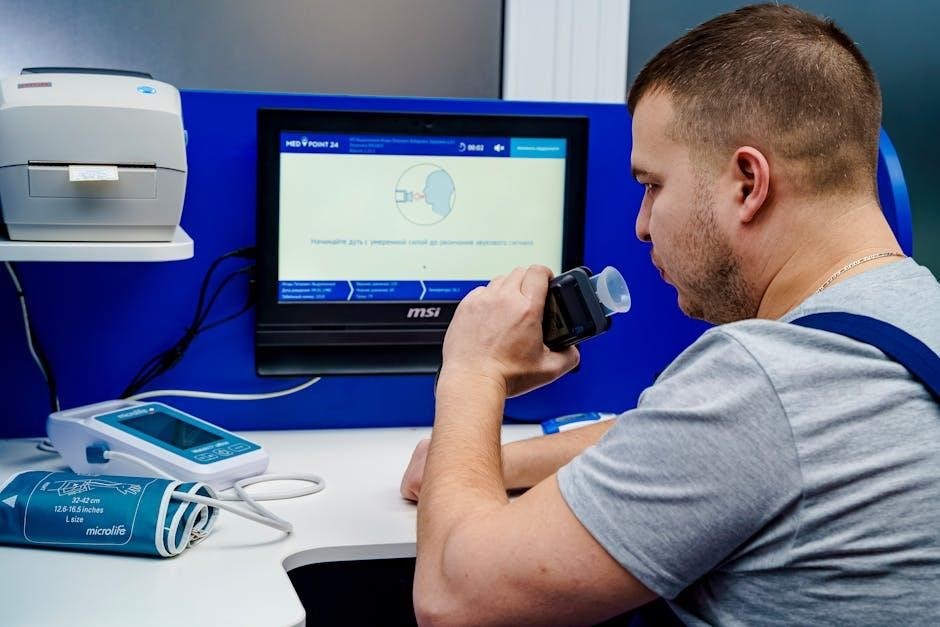
The Helicobacter pylori breath test is a non-invasive procedure typically performed in a clinical setting. First, you’ll be seated comfortably, and a healthcare professional will explain the process. The procedure begins with a baseline breath sample collection – you’ll breathe into a special collection bag or tube. This establishes a starting point for comparison.
Next, you’ll ingest either a capsule containing urea labeled with a special carbon atom (13C or 14C) or a liquid containing the same urea. Follow the instructions in your PDF carefully regarding water intake with the capsule/liquid. A precise waiting period, usually 20-30 minutes, follows. During this time, remain seated and avoid talking, chewing gum, or smoking.
Finally, a second breath sample is collected using the same method as the first. The collected samples are then sent to a laboratory for analysis. The lab measures the levels of the labeled carbon in your breath. A significant increase indicates the presence of H. pylori, as the bacteria break down the urea, releasing the labeled carbon dioxide, which you exhale.
Baseline Breath Sample Collection
The initial step in the Helicobacter pylori (H; pylori) breath test involves collecting a baseline breath sample. This serves as a reference point to measure carbon dioxide levels before you ingest the urea. You will receive a specialized collection kit, detailed in the PDF instructions, typically consisting of a bag or tube.
The technician will guide you through the process. Typically, you’ll be asked to breathe normally into the collection device for a specified duration – usually around 30 seconds to a minute. Ensure a tight seal around your mouth to prevent air leakage, as this can affect accuracy. Avoid hyperventilating or taking excessively deep breaths.
It’s crucial to avoid talking or eating anything immediately before this sample. The baseline sample establishes your normal carbon dioxide production. The collected sample is then sealed and labeled with your information and the date/time. This initial measurement is vital for accurately interpreting the results after the urea challenge.
Urea Capsule/Liquid Administration
Following the baseline breath sample, you will be given either a urea capsule or a urea-containing liquid to ingest, as detailed in the PDF instructions. The form administered depends on the specific testing protocol and patient preference. If a capsule, swallow it whole with a small amount of water – do not chew or crush it.
For liquid formulations, carefully measure the prescribed dose using the provided measuring device. Mix it with a small amount of water, if necessary, and drink it completely. The urea contains a special form of carbon, specifically 13C or 14C, which is non-radioactive and safe. This urea is broken down by the enzyme urease, produced by H. pylori, if the bacteria are present in your stomach.
The breakdown process releases carbon dioxide containing the labeled carbon. This labeled carbon dioxide is then absorbed into your bloodstream and exhaled through your lungs. The technician will confirm you’ve successfully ingested the urea and will start the timer for the waiting period, as outlined in the PDF guide.
Waiting Period and Second Breath Sample
After administering the urea, a specific waiting period – typically 20-30 minutes, but confirm with your PDF instructions – is crucial for accurate results. During this time, it’s essential to remain seated and avoid any physical activity, talking, chewing gum, or eating/drinking anything. These actions can influence the carbon dioxide levels and potentially affect the test’s accuracy.
The technician will carefully monitor the time and alert you when it’s time for the second breath sample. This sample is collected using the same procedure as the baseline sample – breathing normally into the collection bag or tube. Ensure a consistent breathing pattern, as instructed by the technician, to obtain a representative sample.
The second breath sample captures the carbon dioxide produced after the urea has been metabolized. Comparing the levels of the labeled carbon in the baseline and second samples allows the technician to determine if H. pylori is present in your stomach, as detailed in the PDF’s result interpretation section.
Interpreting Your Breath Test Results
Understanding your H. pylori breath test results requires careful consideration, as outlined in the accompanying PDF instructions. The test measures the levels of carbon-13 or carbon-14 dioxide in your breath; A significant increase in these isotopes, compared to the baseline sample, typically indicates the presence of H. pylori.
The PDF will define a specific “cutoff” value – a threshold level of carbon isotope enrichment. If your result exceeds this cutoff, it’s considered a positive result, suggesting an active H. pylori infection. Conversely, if the carbon isotope levels remain similar to the baseline, the result is negative, indicating the absence of detectable infection.
It’s important to note that results aren’t always straightforward. The PDF may include details on “grey area” results – values close to the cutoff – which may require repeat testing or further investigation. Your physician will discuss your results in detail, considering your medical history and any medications you’re taking, as detailed within the PDF.
What Does a Positive Result Mean?
A positive result on the H. pylori breath test, as detailed in the accompanying PDF instructions, signifies the presence of the Helicobacter pylori bacteria in your stomach. This doesn’t automatically mean you’ll experience symptoms; many individuals harbor the bacteria without noticeable issues.
However, a positive result confirms that H. pylori is likely contributing to any existing gastrointestinal symptoms, such as indigestion, bloating, nausea, or abdominal pain. The PDF emphasizes that untreated H. pylori infection can increase the risk of developing more serious conditions, including gastritis, peptic ulcers, and, in rare cases, stomach cancer.
Therefore, a positive test typically prompts your doctor to recommend a course of treatment, usually involving a combination of antibiotics and a proton pump inhibitor (PPI) to reduce stomach acid. The PDF will outline the standard treatment protocols. Following treatment, a follow-up breath test is often recommended (as described in the PDF) to confirm successful eradication of the bacteria.
What Does a Negative Result Mean?
A negative result on the H. pylori breath test, as thoroughly explained in the provided PDF instructions, generally indicates that you do not currently have an active Helicobacter pylori infection in your stomach. This is reassuring, suggesting the bacteria isn’t the cause of any gastrointestinal symptoms you might be experiencing.
However, it’s crucial to understand, as detailed in the PDF, that a negative result doesn’t entirely rule out the possibility of past infection or the presence of the bacteria in a limited area of the stomach; False negatives can occur, particularly if you’ve recently taken certain medications (listed in the PDF) or haven’t strictly adhered to the pre-test dietary restrictions outlined in the PDF.
If your symptoms persist despite a negative test, your doctor may recommend further investigation to identify the underlying cause. This could involve other diagnostic tests, such as endoscopy with biopsy, as referenced in the PDF. The PDF also clarifies that a negative result doesn’t prevent future H. pylori infection, so continued awareness of risk factors is important.
Potential Side Effects and Risks
The H. pylori breath test, as detailed in the accompanying PDF instructions, is generally considered a very safe and non-invasive procedure. Significant side effects are rare, offering peace of mind to most patients. However, it’s important to be aware of potential, though usually mild, reactions.

Some individuals may experience slight abdominal discomfort, bloating, or nausea shortly after consuming the urea capsule or liquid, as noted in the PDF. These symptoms are typically temporary and resolve on their own within a few hours. The PDF also mentions a possibility of mild diarrhea in a small percentage of cases.
Regarding risks, the test poses virtually no physical harm. The PDF clarifies that the amount of urea used is minimal and poses no threat to individuals with kidney problems. Allergic reactions are extremely uncommon. It’s vital to review the complete list of potential, albeit rare, complications outlined in the PDF and to promptly report any unusual or concerning symptoms to your healthcare provider, as instructed within the PDF.

Common Side Effects – Are They Serious?
As outlined in the detailed H. pylori breath test instructions PDF, the most frequently reported side effects are typically mild and self-limiting. These generally include a slight feeling of fullness or bloating in the abdomen, which usually subsides within 30 to 60 minutes post-ingestion of the urea solution, as detailed in the PDF.
Some patients may also experience a mild, temporary metallic taste in their mouth, a sensation clearly explained within the PDF. Occasionally, a very slight nausea can occur, but this is rarely severe enough to cause discomfort, according to the PDF’s guidance. These side effects are not considered serious and do not require any specific intervention.
The PDF emphasizes that these common reactions are a normal response to the test and are not indicative of any underlying health issue. However, if any symptoms persist beyond a few hours, or if you experience any unusual or severe reactions not mentioned in the PDF, it is crucial to contact your healthcare provider immediately, as instructed in the PDF’s post-test section. Generally, the test is exceptionally well-tolerated.
False Positives and False Negatives – Understanding Limitations
The H. pylori breath test, while highly accurate, isn’t foolproof, as detailed in the comprehensive instructions PDF. False positive results – indicating infection when none exists – can occur, though infrequently. These are sometimes linked to recent use of certain medications, specifically proton pump inhibitors (PPIs), even with the washout period recommended in the PDF.
Conversely, false negative results – missing an existing infection – are possible, particularly if the patient has recently taken antibiotics, bismuth-containing medications, or PPIs, despite following the PDF’s preparation guidelines. Incomplete adherence to dietary restrictions outlined in the PDF can also contribute to inaccurate negative results.
The PDF stresses that a negative result doesn’t always definitively rule out H. pylori infection, especially if clinical suspicion remains high. Factors like recent gastrointestinal bleeding or active ulceration can sometimes interfere with test accuracy, as noted in the PDF. If discrepancies arise between test results and clinical presentation, your doctor may recommend further investigation, as suggested within the PDF’s follow-up section. Understanding these limitations is crucial for appropriate interpretation.

Post-Test Instructions and Follow-Up
Following the H. pylori breath test, as detailed in the provided PDF instructions, you can generally resume your normal diet and activities immediately. The PDF emphasizes that the test itself is non-invasive and carries minimal risk, so significant post-test restrictions aren’t usually necessary. However, it’s crucial to adhere to any specific instructions given by your healthcare provider.
Your doctor will discuss the test results with you, typically within a few days, as outlined in the PDF’s timeline. A positive result confirms the presence of H. pylori and will likely prompt a course of antibiotic therapy, often a triple or quadruple regimen, details of which are available in the PDF’s treatment section. The PDF also highlights the importance of completing the entire antibiotic course, even if symptoms improve.
If the test is negative, but your symptoms persist, further investigation may be needed, as suggested in the PDF’s troubleshooting guide. This could involve repeat testing, endoscopy, or other diagnostic procedures. The PDF stresses the importance of open communication with your doctor to ensure appropriate management and follow-up care, tailored to your individual needs.
What Happens After the Test? – Treatment Options
If your H. pylori breath test, as detailed in the PDF instructions, returns a positive result, treatment is typically recommended to eradicate the bacteria and prevent complications. The PDF outlines standard treatment protocols, usually involving a combination of medications – typically a proton pump inhibitor (PPI) to reduce stomach acid, and multiple antibiotics to kill the bacteria. These regimens, often “triple therapy” or “quadruple therapy,” are thoroughly explained within the PDF.
The PDF emphasizes the critical importance of adhering strictly to the prescribed medication schedule, completing the full course even if you feel better. Antibiotic resistance is a growing concern, so consistent treatment is vital for success. Follow-up testing, usually another breath test conducted 4-8 weeks after completing treatment (as per the PDF’s timeline), is essential to confirm eradication.
If the initial treatment fails, as detailed in the PDF’s troubleshooting section, your doctor may prescribe a different antibiotic combination. Lifestyle modifications, such as avoiding smoking and excessive alcohol consumption (also covered in the PDF), can also support healing and improve treatment outcomes. The PDF serves as a valuable resource for understanding your treatment plan and potential side effects.